The Name
Schmalschläger is a compound German surname built from two elements:
- Schmal — meaning “narrow” or “slender” in Middle High German
- Schläger — derived from slahen, meaning “to strike” or “to beat”
The name belongs to Germany’s rich tradition of occupational surnames. A Schmalschläger was likely a craftsman whose trade involved striking or forging narrow objects — possibly a blacksmith working narrow blades, a woodworker, or someone clearing narrow forest plots (a Schlag in German can also mean a cleared woodland area).
The surname falls into the broader category of German names ending in -schläger, alongside similar occupational names found across the German-speaking world.
The Homeland: Bergisches Land
The Schmalschläger family traces its origins to the Bergisches Land, a scenic, hilly region east of Cologne in what is now North Rhine-Westphalia. Specifically, the earliest known family members lived in:
- Rossenbach — a small village in the Oberbergischer Kreis. Johann Jakob Schmalschläger was born here in 1834.
- Oberlückerath — a district of the municipality of Ruppichteroth, where the family farmed the land. Helena Schmalschläger was born here in 1868.
- Reichshof — in the same Oberbergischer Kreis district, where the Schmalschläger name persists to this day through a family business.
The Oberbergischer Kreis (Upper Bergian District) lies in the southeast of the historical County of Berg, a medieval earldom known for its rolling hills, dense forests, and traditional craft trades. It was from this landscape of forested valleys and small farming communities that the Schmalschläger family began its story.
GenWiki surname distribution maps from 1890 confirm the name’s concentration in this exact area of the former German Empire.
Migration to the Netherlands
In the second half of the 19th century, a branch of the Schmalschläger family crossed the border into the Dutch province of Limburg, settling in the town of Brunssum. This region of the southern Netherlands shares deep historical and cultural ties with the adjacent German-speaking areas.
The migration was driven in part by the political turmoil of the era. With the Franco-Prussian War looming, strict military conscription in the Prussian Empire pushed a number of Germans to flee across the border. Among them was Gerard Schmalschläger (1845–1901), born in Waldbrühl in the Oberbergischer Kreis. Local oral tradition remembers him as “Mathias” — likely his Rufname (call name), a common practice in 19th-century Germany where a person’s daily name differed from the one recorded in civil documents.
The Bouwberg Home
Gerard built a small cottage on the Bouwberg from wood, straw, and clay. The timber came from the Count of Amstenrade, for whom he had worked. He moved in with his family in 1871 and made a living trading in rags and scrap metal, crafting brushes and brooms from horse and pig hair, and baking bread and vlaaien (traditional Limburgish fruit pies) — all sold throughout the surrounding area.
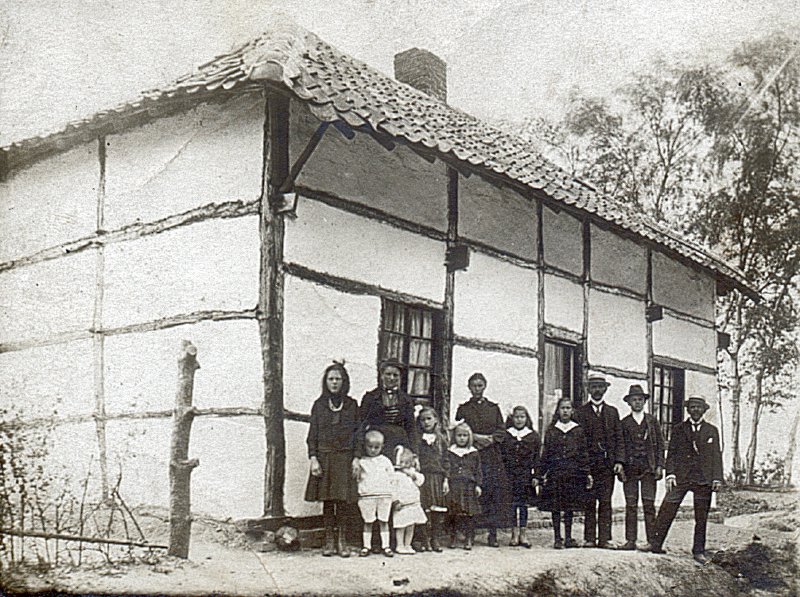
The half-timbered cottage, known locally as het huisje van Duppessjurger, still stands at Bouwbergstraat 78 . It is a rare surviving example of this type of modest dwelling and has been classified as a Rijksmonument — a national heritage site protected by the Dutch government.
Bouwberg HouseGerard married Maria Hubertina Notermans in Aachen in 1869, and together they founded the entire Dutch branch of the family:
Dutch Branch — LimburgSchmalschläger Family TreeThe German Branch — A Century in Eckenhagen
While one branch of the family migrated to Limburg in the 1860s, another remained in the Bergisches Land — and is still there today. The village of Eckenhagen (now part of the municipality of Reichshof) has carried the Schmalschläger name continuously for more than a century and a half.
Wilhelm Schmalschläger , born in Eckenhagen in 1901, lived his whole life in the village and worked as a Pflasterer (paver). On 12 January 1951, at the Schützengesellschaft’s annual Winter Festival, he was named an Ehrenmitglied (honorary member) of the Allgemeine Schützengesellschaft 1857 e.V. zu Eckenhagen — the village shooting society — alongside five other long-serving local members. The honor recognized decades of service to the village’s oldest civic institution.
Two generations later, the family business Schmalschläger GmbH still operates from Blockhausstraße 1 in Reichshof-Eckenhagen, run by Achim Schmalschläger and registered with the Amtsgericht Köln (Cologne district court) under HRB 59553. The thread from Wilhelm the paver in 1901 to Achim the entrepreneur today is unbroken — roughly 125 years and counting in the same village where the family name first appears in the 18th-century parish books.
Schmalschlägerstraße — A Street Named After Its Builder
In the Bavarian Alps, in the spa town of Bad Reichenhall, there is a street that carries the family name: the Schmalschlägerstraße. Built in 1906–1907 by Johann Schmalschläger , a master builder originally from Börlinghausen in the Oberbergischer Kreis, it is the only street in all of Germany named after a Schmalschläger — and the only street in the city named after its builder. A commemorative marble plaque, now a protected monument, still honors him at the roadside.
SchmalschlägerstraßeThe Family Today
From those villages in the Bergisches Land and the streets of Brunssum, the Schmalschläger name has spread across Germany and the Netherlands. Today, family members are active in fields ranging from law and physics to gastronomy, public administration, and the arts.
The Dutch branch remains rooted in Limburg — most notably, Désirée Schmalschläger, who serves as mayor of the municipality of Leudal. The German branch maintains ties to the Oberbergischer Kreis through the family business in Reichshof, while other Schmalschlägers have made their mark in Munich, Frechen, and Rotterdam.
The name is rare — but those who carry it share a common thread that stretches back to the hills and forests of the Bergisches Land.