The Only Schmalschläger Street in Germany
In the Bavarian Alps, in the spa town of Bad Reichenhall, there is a street that carries the family name: the Schmalschlägerstraße. It is the only street in all of Germany named after the Schmalschläger family — and it has a remarkable origin story.
Built by Johann Schmalschläger
The road was built in 1906–1907 by Johann Schmalschläger, a Baumeister (master builder) in the Karlstein district of Bad Reichenhall. Born before 1865 in Börlinghausen, a hamlet in the municipality of Marienheide in the Oberbergischer Kreis — the very same district as the family’s known ancestral villages of Rossenbach, Oberlückerath, and Reichshof — Johann later moved to Bavaria, where he married Mathilde Mayr, a merchant’s daughter from Munich, on January 24, 1887. The formerly independent municipality of Karlstein honored him by naming the street after him — making it the only street in the city named after its builder.
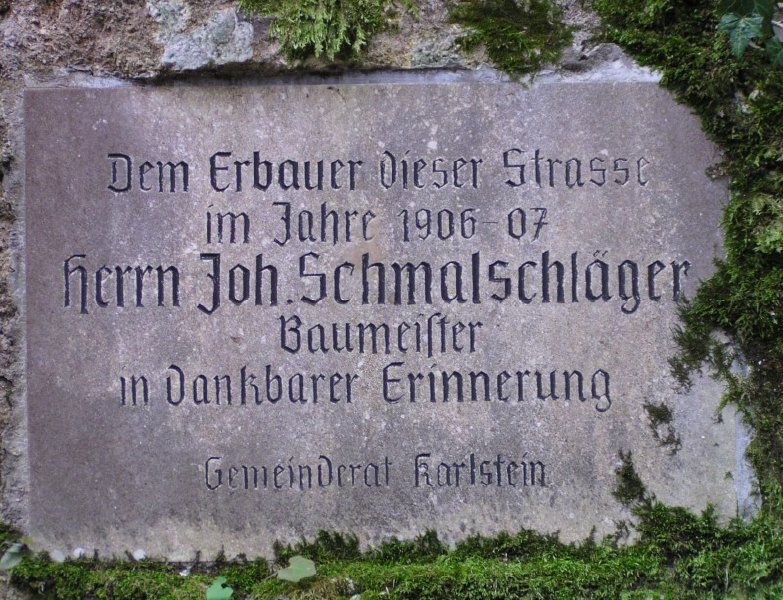
A commemorative marble plaque at house number 12, mounted beneath a wayside cross on a roadside rock face, reads:
“Dem Erbauer dieser Straße in den Jahren 1906–1907, Herrn Joh. Schmalschläger, Baumeister, in dankbarer Erinnerung.”
“To the builder of this street in the years 1906–1907, Mr. Joh. Schmalschläger, builder, in grateful remembrance.”
The marble plaque (0.4 x 0.6 m) was restored around 1980 by the Verein für Heimatkunde (Local History Association) and is now a protected monument.
The Route
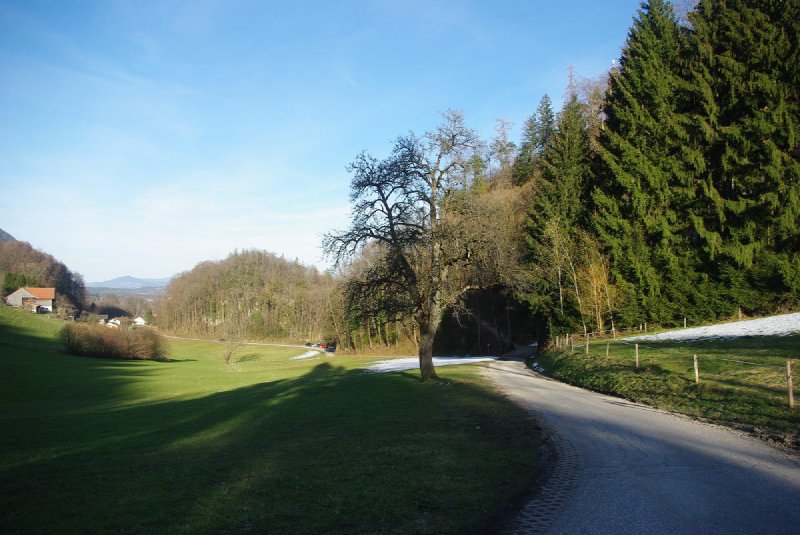
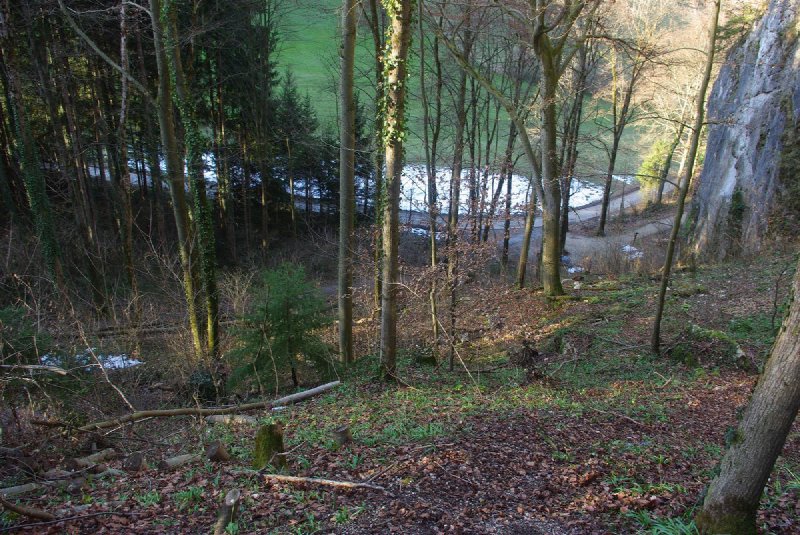
The Schmalschlägerstraße is 1.14 km long and climbs nearly 100 meters in elevation. It branches off from Thumseestraße (State Road St 2101) at the historic Gasthof Kaitl inn — itself a protected monument. After climbing steeply with tight curves, the street forks into two dead-end branches terminating at the Palfner and Mesnerbauer farms high above the valley.
Along the route you’ll find:
- No. 2 — Gästehaus Beer-Staufner, a traditional guesthouse
- No. 5 — Mehrzweckhalle Karlstein (community hall)
- No. 5a — Grundschule Karlstein (elementary school)
- No. 5b — Kindertagesstätte Karlstein (kindergarten, opened 1974)
- No. 12 — The commemorative plaque and wayside cross
- No. 15 — Parking for Karlstein Castle ruins and St. Pankraz Church
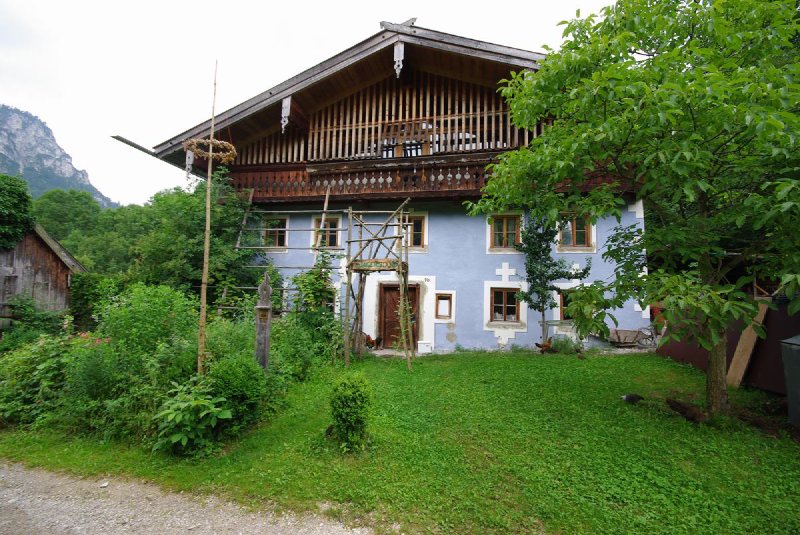
- No. 16 — Bauernhof Palfner, a protected heritage farmstead
- No. 20 — Landhaus Mesnerbauer, vacation apartments at 650m elevation
Karlstein: Ancient Ground
The area around the Schmalschlägerstraße is of remarkable archaeological significance. Excavations conducted between 1901 and 1905 uncovered Bell Beaker culture pottery — the oldest evidence of human habitation in the entire Reichenhall valley. The finds also include nine Bronze Age dwellings and artifacts from the Urnfield, Hallstatt, and Late La Tene periods, spanning thousands of years of continuous settlement.
From the upper end of the street, hiking trails lead to the Karlstein Castle ruins (built c. 1150) and the St. Pankraz pilgrimage church (15th century, rebuilt 1687–1689), offering panoramic views over Bad Reichenhall and the surrounding Alps.
Location
The Schmalschlägerstraße is located in the Karlstein district of Bad Reichenhall, an Upper Bavarian spa town in the Berchtesgadener Land district — close to the Austrian border near Salzburg. From Munich, Bavaria’s capital, the drive is approximately 140 km southeast along the A8 autobahn, passing the Chiemsee lake — roughly 1.5 hours by car.
A Bergisches Land Connection
Johann Schmalschläger’s origins in Börlinghausen — confirmed by his 1887 Munich marriage record, which describes him as “Schmalschläger Johann, Baumeister v. Börlinghausen” — place him squarely in the Oberbergischer Kreis, the ancestral home of the Schmalschläger family. Börlinghausen is a hamlet in the municipality of Marienheide, just a few kilometers from Rossenbach and Oberlückerath, where the earliest known Schmalschlägers lived. His exact relationship to the wider family remains an open question for future genealogical research, but his origins leave little doubt that he belongs to the same Bergisches Land family tree.